- Project
- Admirals
- My role / type
- Head of Design
- Dates
- Feb 2024–Present
- Focus
- Positioning · Client value · Omnichannel analytics · AI production
0Surface

Winning experienced traders with credibility instead of “easy start” promises — and measuring clients by value, not volume.
−1Why?
The traders worth winning — the ones who already know what they need — are the least moved by an easy-start pitch.
−2Why?
A count of new clients says nothing about whether they stay or fit the business.
−3Core
Count value, not volume.
“We shifted the focus from the number of clients acquired to the quality and business value of those relationships.”
My partMy role was to translate that direction into the website’s proposition, content hierarchy and customer journeys. I reshaped the design team around senior designers with more responsibility for decisions and execution.
=Proof
Key outcomes
- Customer acquisition cost
- −67%
- Two-thirds lower than the previous CAC, with customer journey improvements contributing to the reduction.
- First-time deposits
- +16%
- Increase in first-time deposits.
- Conversion
- +11%
- Improvement in conversion.
- Registration entry
- +7%
- Conversion into registration after redesigning Sign Up from one screen to seven.
- Monthly revenue
- +€400k
- Additional monthly revenue from a targeted UI change.
Broader business impact: annual losses reduced from €10M to €1.6M through a focus on retention and unit economics.
In brief
Brokers competed on “easy start” promises and counted new clients. We bet on the opposite: earn the experienced trader’s trust, and judge acquisition by the value of each client.
The problem
A category built on easy starts
Online trading was crowded with “easy start” promises and short-term acquisition hooks, and success was measured by the number of clients a campaign brought in.
But a count of new clients says nothing about whether they stay or fit the business. And the traders worth winning — the ones who already know what they need — are the least moved by an easy-start pitch.
The bet
Earn the experienced trader’s trust
I took part in shaping a strategy focused on the upper stages of Hunt’s awareness ladder: experienced traders who already understand the category, know what they need and are evaluating their next broker.
These clients value trust, operational stability and honesty. They need transparent conditions, dependable processes and evidence that the broker can support the way they trade.
So we made credibility the core proposition. The aim was to attract traders whose expectations and needs matched Admirals’ offering. My role was to translate that direction into the website’s proposition, content hierarchy and customer journeys.
The audience
Four audiences. Four reasons to switch.
These were the core audiences we aimed to attract. Each had a specific reason to reconsider their current broker, and each needed a proposition that addressed it.
| Audience | Why they reconsidered their broker | What we needed to make clear |
|---|---|---|
| TrustThe Trust-Seeking Trader | Low confidence in the broker’s alignment, fund safeguards and withdrawal processes. | Regulation and fund segregation, transparent processes and dependable withdrawals — reasons to trust the broker over the long term. |
| IndicesThe Index Specialist | Wide spreads on GER40 and SP500, limited position sizing and a generic retail-account experience. | Fair and competitive index-trading conditions, flexible sizing and clear commission terms for active traders. |
| MetaTraderThe MT Power User | A basic MT5 setup without the tick charts, risk-management tools and automation they need, plus charges for useful extras. | Advanced tools for MT4 and MT5 included: tick charts, a mini-terminal and enhanced trading add-ons. |
| Trading + investingThe Hybrid Investor | Separate apps, logins and fees for CFD trading and long-term stock investing, with no connected view. | CFDs, stocks and ETFs within one ecosystem, with connected account management and transfers between accounts. |
The proposition
Make credibility visible
I led the redesign of the company’s web experience around that audience strategy. The work connected customer journeys, information architecture and visual direction with the questions an experienced trader brings to a broker comparison.
Trust signals, trading conditions, platform capabilities and the connected ecosystem became part of one coherent story. The website and trading account recordings show how that direction reached the experience.
The brand
A consistent presence on social
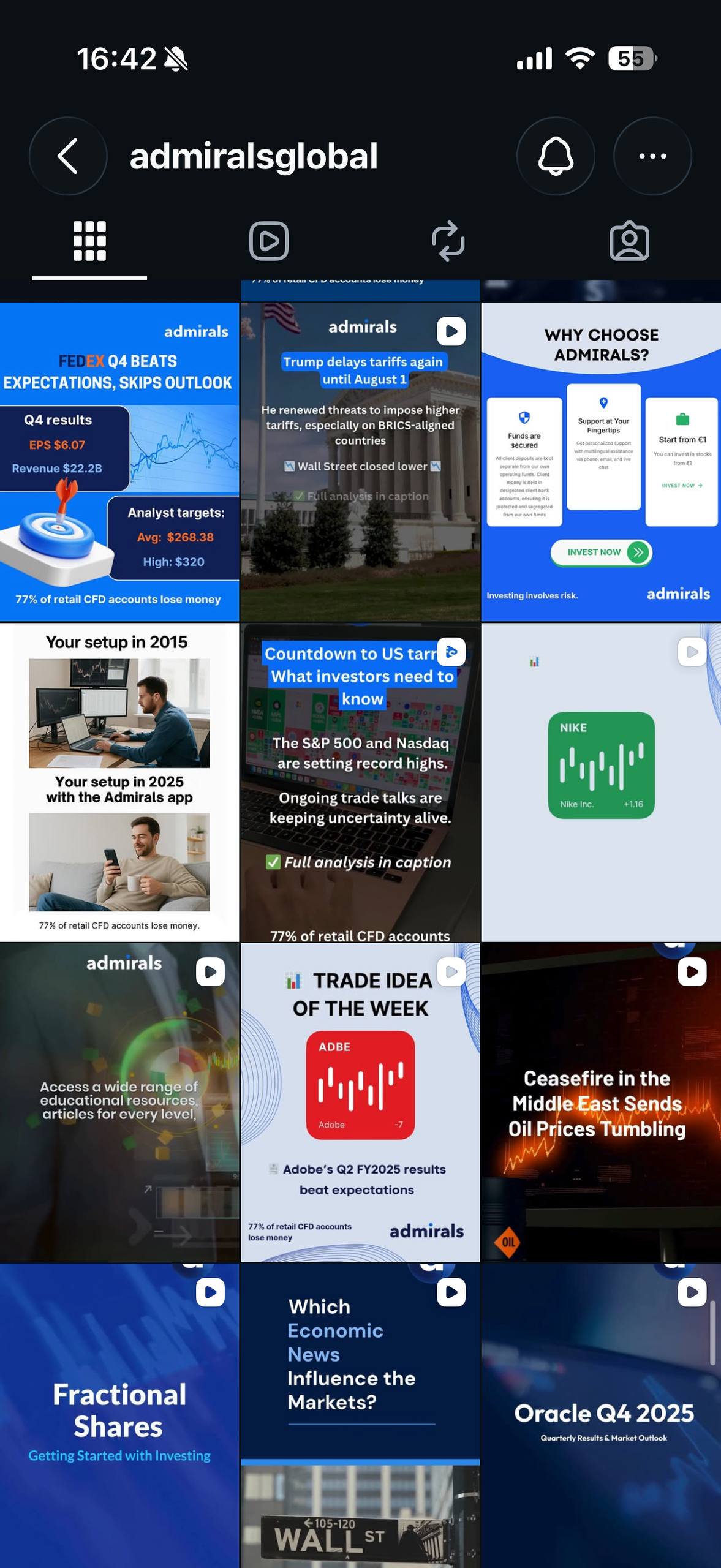
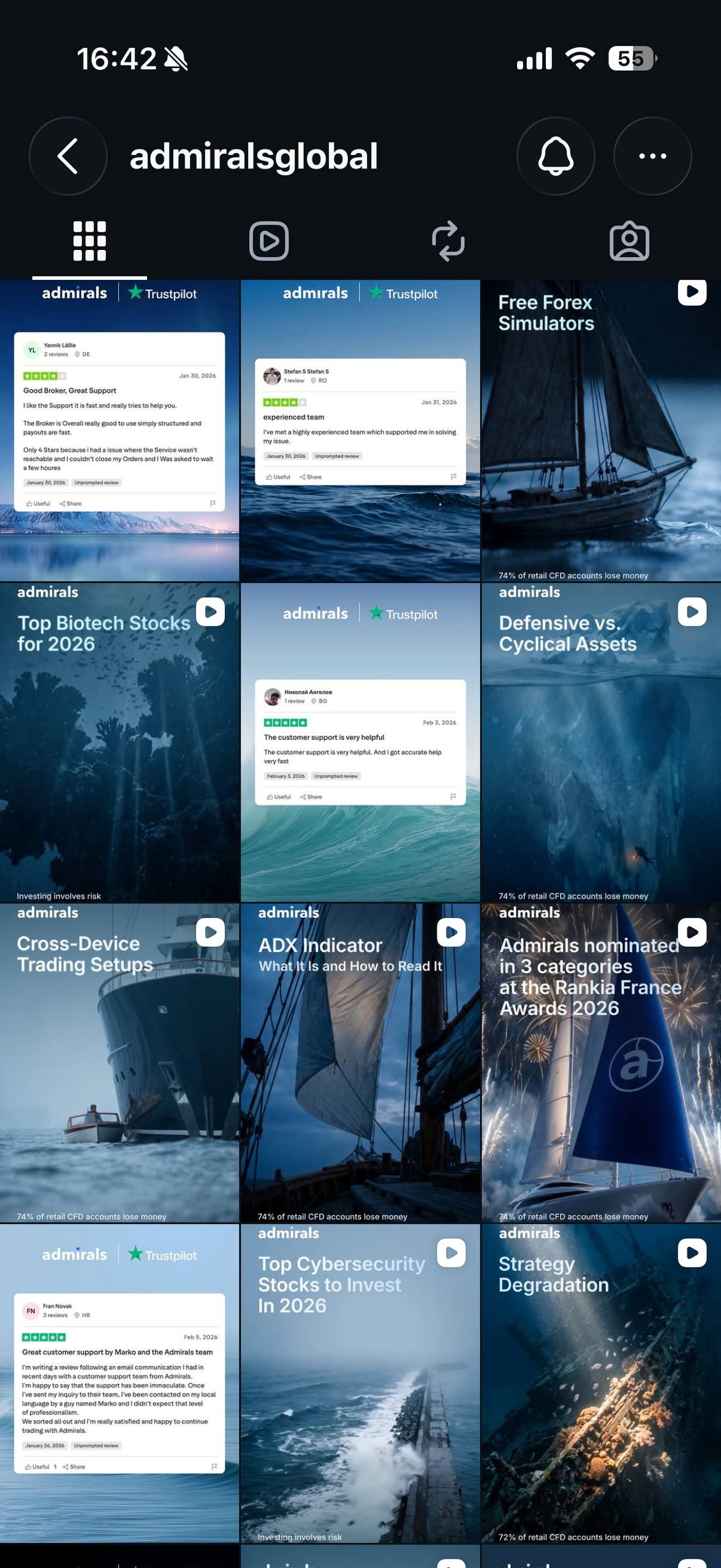
Across educational content, market commentary and client reviews, the refreshed feed uses a shared blue and teal palette, maritime imagery and consistent typography. Repeated headline and logo placement, alongside a dedicated review template, make the content feel like one brand.
The journey
From one screen to seven
I redesigned the Sign Up flow from a single screen to seven screens. The redesign increased conversion into registration by 7%.
The measure
Count value, not volume
We shifted the focus from the number of clients acquired to the quality and business value of those relationships.
As part of that change, we introduced Client Business Value (CBV) as a new parameter and reworked the analytics. It brought client quality into acquisition reporting and gave us another way to assess the value of the clients our marketing attracted.
The audience strategy and its measurement now addressed the same question: are we attracting clients whose needs fit the business and create a valuable relationship?
The channels
See each channel’s contribution
We also added omnichannel analytics to understand how marketing channels contributed across the client’s journey to acquisition.
The goal was to move beyond attributing a client only to the final touchpoint. By connecting the interactions leading to acquisition, we could see the contribution of each marketing channel and how those channels worked together.
This connected positioning, design and acquisition measurement: which audiences we were reaching, what supported their decision and which channels contributed to bringing them to Admirals.
The result
Better clients, at a lower cost
Customer journey improvements contributed to reducing the cost of acquiring a client to a third of what it was. First-time deposits grew by 16% and conversion by 11%, and a single targeted UI change added €400k in monthly revenue.
With the focus on retention and unit economics, annual losses fell from €10M to €1.6M. Trust proved to be the right promise to experienced traders — and good business, too.
The team
Build more ownership
I reshaped the design team around senior designers with more responsibility for decisions and execution. Research, behavioral analytics and experimentation became part of how problems were understood and prioritized.
The aim was a team that could explain its choices, challenge assumptions and carry work through to a stronger result.
The workflow
Change the production workflow
I reorganized web production from a workflow supported by six developers to two designers using Claude and one developer. I configured Claude with marketing strategy, design direction and brand guidelines so the generated work had the necessary context.
AI also helped audit years of product and web legacy, identify repeated patterns, document components and interaction states, and compare implementation with the design system through Figma MCP. I built working prototypes and a creative compliance checker, and ran workshops to help colleagues apply the tools.
Live product
Admirals still leads with trust.
The bet is visible on the live site: trust signals, trading conditions and platforms up front, written for traders who already know what they need.
Visit Admirals